Tuesday, December 04, 2007

Islamic Global Peace & Unity in London

The comfortable and familiar feeling of being among a sea of Muslims returned when I attended the Global Peace & Unity event held in London on November 24 and 25. There were literally tens of thousands of Muslims from South Asia, Africa and the Middle East. Everyone looked the part, largely dressed in a way that set them apart from the rest of the British population. There were elegant East African women -- tall, thin, dark, and often carrying themselves with striking beauty. The South Asian women varied from those who wore an all enveloping hijab that left only the eyes visible--often thick with makeup--to those who made no attempt to hide their feminine charms. Likewise, their menfolk included men with imposing black beards and others whose visits to mens grooming saloons must have been at least once a week. Confusingly, the majority of this vast crowd spoke English with a thick working class British accent. My eyes were telling me "that man sure looks Arab" while my ears were saying "but he certainly sounds English". I was immersed in a mixed-up world of multiple identities and generational allegiances, where English was Arab and Pakistani was English, and where half the women wore cheap Chinese made Palestinian style kaffiyehs despite having almost certainly never set foot anywhere near Jerusalem.

Muslim woman
Muslim woman

There was a large room with all kinds of small booths and stalls offering things for sale and causes to contribute. One popular stall painted small flags on women and girls' cheeks, and henna on their hands.

There was a man and woman selling Muslim T-shirts. A brown shirt said simply resistance, and had a picture of an automatic weapon. A blue shirt had a superman logo that said "Muslims do it 5 times a day". But the finest was a red shirt with ISLAM in large letters, whose 'M' was in the style of the famous McDonald's logo. Beneath it was the slogan "I'm lovin it". I looked at it intently with a no doubt perplexed look on my face. I asked the man if he thought the shirt was sacrilegious. Without a hint of irony or humour, in his British accent he told me he didn't know what sacrilegious meant. I told him it meant it was against the sacred nature of Islam. He replied that he had designed the shirt himself, and that some Muslims loved it while others hated it. He thought it was practical. Imagine, he said, a young Muslim man being confronted by drunks on an underground railway station at 11 p.m. The drunks would find the shirt amusing, giving the upstanding Muslim the perfect opening to preach the glories of Islam. His wife was standing beside him, her face covered, busy serving customers. I did not know what she thought of such practicalities.

Mr McIslam
Mr McIslam

I asked a man selling a military biography of Khalid ibn al-Walid, otherwise known as the Sword of Allah, whether this was an appropriate book for a peace and unity event. He admitted he had not read the book and could not say. Before asking him this, I had taken his photo alongside it, honouring his request to include the honey he was also selling.

There was a booth with a bearded man bellowing loudly into the ear of a young woman. Above them was a sign promising to assist those suffering from evil eye, black magic, or jinn possession. The man was effective. Soon enough, the woman broke down in tears. While all this was going on, I asked his son of I had permission to photograph the sign advertising their services. He told me to go ahead. I took the photo, his father noticing out of the corner of his eye. He stopped helping the woman and began to berate me for daring to take a photograph. I let him speak, and when he was finished, I told him I had merely photographed the sign with his son's permission. His temper flaring, he demanded to know I was a journalist. I said I was not. He was agitated and I realised it was best to listen to him quietly and calmly. He said in his booming voice that British journalists had made a mockery of his work, and a French television station had confused him with a man wanted by the police, giving him all kinds of things to worry about. A elderly man beside me became very angry and demanded to know what I was doing there with a camera. I said nothing but looked him in the eye, which he took to be a sign of aggression. The curer of evil eye, black magic and jinn possession calmed down at this point, and told the other man he could handle it. I reassured him that at no time had I photographed anything but their sign. I gave him my card and expressed my sympathy for his predicament. He smiled, apologised, and resumed his work. The elderly man also smiled apologetically.

The massive crowd
The massive crowd

I came across a booth where a wife and husband of Pakistani origin had enterprisingly set up a small photographic studio. We struck up a long and fruitful conversation. The wife told me about their photography business, emphasising her skills as a woman photographer, which was very useful with the upsurge in gender segregated weddings. They were dull to photograph, she said, because they lacked the interaction between the groom and bride that made wedding photography so special. But it was good for business. In our discussions on Muslim marriages she told me that she believed a woman should always have the right to choose her husband, no matter what anybody else in the family says. She herself was married at age 17, without ever having met her husband till the day she was married. While she had a marvellous marriage with three children, she said as women became better educated they were demanding their right to choose their husband themselves. A skinny pimple faced young man came up to the booth, examining the beautiful bridal photographs on display. She offered him her brochure, at which point he realised that he was not at a booth offering to match potential brides and grooms. His friends laughed at him. The woman pointed out that all the brides were already married, and her husband pointed to a portrait photo of a girl who was about three years old, mentioning that she was not married. We all laughed.

I joined a crowd of many thousands enjoying musical performances taking place in a huge auditorium. On stage were a continual stream of earnest musicians emphasising their wholesome family values and commitment to Islam. It was in fact uplifting family entertainment suitable for the many young children present. The organisers wisely interspersed the more somber acts with a dash of humour, which proved to be a big hit. A Californian named Baba Ali had everyone laughing when he described how a Muslim could get thrown off a plane. One suggestion was to scream loudly in Arabic. Another was to turn to a friend mid-flight, waking him up and saying loudly "Osama, it's time, it's time." He said that wearing a hijab would not get you thrown off a plane. Neither would a large beard. But wearing a hijab while having a large beard probably would.

Baba Ali
Baba Ali

Saturday, November 17, 2007

The woman on the train

I saw her first at the underground railway station. She was about 30. Her face was red. It must have been a cold. She had a book with her. It was written in Turkish. I also had a book, by VS Naipaul. After arranging her clothes she settled into her seat to read. The train approached. She quickly got up, anticipating the train's arrival. We both needed a seat. We each found one. We smiled at each other. It is much easier to read while sitting. She opened her book and resumed her reading. I resumed mine. But she was too intriguing, so I ignored my book and watched her as she traced her finger over the words she was reading. Soon she was speaking the words to herself, immersed in the world the pages conveyed. The author's mind and her mind were meeting as the stations came and went. The author did not know. But I did, watching this woman on the train.

Saturday, October 20, 2007

God's villages

Once there was a man walking in a field with God. As they passed near a village, God asked the man if he knew the people living there. The man said he did. God asked him if he knew their religion. The man said “they are Jews.” The pair continued to walk and eventually they passed beside another village. God asked the man if he also knew the people in this village. The man said he did. God asked him he knew their religion. The man said “they are Muslims”. They continued walking and saw more villages. One was Christian. Another was Hindu. One was even Buddhist. God asked the man why the villages had different religions. The man thought about it for a long time. The only answer he could give was that the village children learned their religion from their elders, who were taught by their elders, going back generations, all the way to their prophets. God asked the man if he could explain why a certain child was born in one village and not another. The man said “only you know that”.

Wednesday, October 10, 2007

Laylat Al Qadr in Jerusalem

Upon recently arriving in Jerusalem, I was determined to go to the Haram Al Sharif and into Al Aqsa Mosque on the night of Laylat Al Qadr (you can read more about this holy night here and here). Many Muslims are unable to travel to the Al Aqsa Mosque and the Dome of the Rock, their third holiest site. It is therefore a great privilege for me to go there, and I wanted to make the most of it.

I walked in the direction of the Haram Al Sharif from Damascus Gate, down through the streets of the Old City of Jerusalem. There were many people--mothers holding tightly onto small babies, old men wearing their "kafiyeh" (head dress), and old women walking leisurely on the way. All were making their way to or from the Haram Al Sharif. The Old City's streets are narrow in some places. Because the shop keepers like to put seemingly half of their shop's goods for sale on tables outside their shop, the streets became even narrower. Pop music sung by women from Lebanon was heard bellowing out of one shop, while another not far away had Qur'anic music sung by groups of men with deep voices. Shop keepers yelled out what they were selling and how much it cost. "Hamseen sheckels!" they yelled again and again. Even the young boys working on behalf of their father or uncle had booming voices that no one could fail to miss. Smoke from meat burning on barbecues and countless water pipes hung in the air almost everywhere.

I finally arrived at my favorite entrance to the Haram Al Sharif, not far from the Western Wall. There were many thousands of men and women praying. Most of the women were in a different area from the men, around the Dome of the Rock, but there were a few women under the covered walk ways off to the side of the men. Some of these women were looking after small children. But others were quite old, and I am unsure why they were not with the other women. No one seemed to mind. It was all quite relaxed.


Praying on the Haram Al Sharif

While the men were praying with devotion and concentration, there were other men shouting out what food they were selling from their stalls. I did not expect people to be buying and selling things on such a holy site during one of the most holy nights of the year.

I immediately found a spot to join the men praying, and I did this for some time. Since I was off to the side, it was a safe place for me to start. After discretely taking a few photos, I went to another spot to pray. This time I went down the front, very close to Al Aqsa Mosque, and much more in the open.

I was doing the prayers like the other men, and soon another man came to pray beside me. I thought to myself "ahh, now I am really in the middle of things!" Many thousands of us prayed, and this particular set of prayers went on for perhaps another 20 minutes. There was a lot of Arabic that I did not understand but for me it did not matter. The main thing was that I was praying sincerely to God, with all my heart. I gave it my best concentration, and I felt my consciousness was changing. By this I mean that when I was focused on God in such a holy place, there was a special feeling in my mind that I cannot describe. All I can really say is that it is not an emotion. Just like when we fall asleep, our consciousness changes. In this case, it was changing but I was of course very much awake! It was wonderful to be in the midst of such a huge crowd of people praying to God on such an auspicious night.

When we finished, the man beside me turned to me and he said "you made many mistakes". I said "yes you are right, it is to be expected because I am very new to this". He asked me "are you Muslim or a tourist?" I gave him my answer, and he told me he wanted to teach me about Islam. While I think all prayers offered with sincerity are as real as each other, it is of course best to show respect for what is considered correct, so I was eager to hear what he had to say about correct ways to pray. I listened to what he had to say. Instead of talking about prayer, he emphasized the elements of cleanliness and purity. He liked what he was teaching, but I could not help but think he should have talked to me a little more first to understand exactly what he needed to teach me! However it was still good to listen to him.

After we finished our discussion, I went straight inside the Al Aqsa Mosque. It was not my first time there, but it was my first time on the night of Laylat Al Qadr. There was hardly any room to pray. There was many people and many things were taking place at the same time. Someone was giving a political speech about America and Israel. Some men were praying. Some were sleeping. Others were looking at everyone who walked by them.


Inside Al Aqsa Mosque

There was little emotion from the people praying and waiting inside Al Aqsa Mosque, giving the occasion a very different temperament than might be had a Shi'ite place of prayer, for example. My initial impression is that Sunnis seem to be more reserved than Shi'ites. Personally I prefer the more emotional and passionate approach--I cannot but help think of the example of Sri Ramakrishna on the occasion of religious festivities. Perhaps it will sound strange for me to mention a Hindu man as a role model, but for those who know of the life example of Sri Ramakrishna, it is of absolutely no surprise at all!

Saturday, September 22, 2007

The dysfunctional relationship between the U.S. and Iran

In a piece sadly typical of the mainstream U.S. news media, Adam Goldman's idea of critical news journalism is to join the chorus attacking Iranian President Ahmadinejad. I certainly have no problem with any journalist critiquing the powerful, including of course President Ahmadinejad. The job of any decent journalist should be to understand power, to expose lies and to report the truth. Naturally a critical stance is absolutely fundamental to this. Like any powerful leader, there is plenty to write about President Ahmadinejad and his supporters. Yet Mr Goldman uses his critical stance only to critique the enemies of successive U.S. government administrations, including President Ahmadinejad. The U.S. entirely escapes his critical glare. His use of quote marks to describe American aggression are particularly revealing.

Missing is any acknowledgment of the deeply dysfunctional relationship between the U.S. and Iran, going back decades now. Few Americans are aware that in the 1950s Iran had a democratic government and a popular Prime Minister in Mohammed Mossadegh. This government was destroyed by the combined talents of the British and U.S. intelligence services, who in 1953 sponsored a coup and replaced it with a dictatorship far more accommodating to Western oil companies. The dictatorship led to the Iranian revolution in 1979.

During this entire period the relationship between the two countries could only be described as dysfunctional. Even the years of the dictatorship in 1953-1979, when government-to-government relations were good, the type of relationship between the two countries can hardly be described as healthy. U.S. support for the dictatorship was in no way meant to be something designed for the betterment of Iranians and their country. Instead, it existed to further the power and wealth of Western companies. Any benefits to Iranians were tangential to this objective.

The 1979 Iranian revolution of course dramatically changed the nature of the government-to-government relationship, and from my perspective the two governments did much to ensure the relationship between the two countries would remain poor. There were significant exceptions of course, such as the efforts toward dialog during the administration of former Iranian President Mohammad Khatami. Yet on the whole, progress has been disappointing, which is the responsibility of both countries.

It is ironic that Mr Goldman's article finishes with a recognition of the right to free speech, given how much his own article resembles those found in countries with strict media censorship. It's all pretty much the same fare - "we are the good guys, with superior values and deeds, and they are the bad evil doers". It's an approach to journalism that any dictator would be satisfied with.

Friday, September 21, 2007

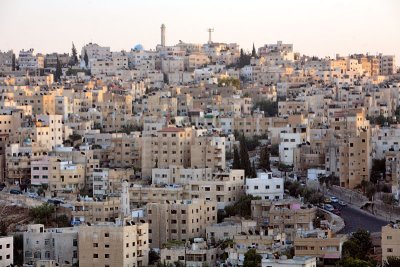
Amman, an ancient city still growing up

People have been living in what is today Amman, Jordan for many thousands of years, with archaeological evidence pointing to the existence of Neolithic civilisation in 6500 BC. In one respect, Amman is a very old city indeed. In other respects, it is a rapidly growing pugnacious youngster. It lacks the Grand Bazaar found in other Middle Eastern metropolises. It lacks the parks and historic monuments. Despite the fancy five-star hotels and advertisements for global cell phone companies, it still retains a somewhat village feel.


For instance, yesterday I visited the Post Office to mail a package overseas. The man in the Post Office was kind and helpful, informing me that it closed at 3:30 p.m. I returned at 3:20 p.m., thinking I had plenty of time to spare. Alas! While the door to Post Office was indeed open till 3:30 p.m., there were no services available from 3 p.m., because as he explained he had to count the day's takings. Curiously, the Post Office contained no postal supplies like envelopes and boxes. He informed me that I needed to buy them somewhere else. The next day I found a stationery shop which did sell such supplies. However the shop had only one padded envelope, and it was very large. I was unsure whether the Post Office would accept it. So the shopkeeper told me to go to the post office and check, and if it was okay, I could then return and pay him for the envelope. Given that we had never seen each other before, I thought that was really very kind and trusting of him.

Thursday, September 13, 2007

Pervez Hoodbhoy, modern Muslim hero?

I met Pervez Hoodbhoy in 2001 at Quaid-i-Azam University in Islamabad. We spent some hours together. We exchanged ideas on religion and science, and he shared a little of his relationship with the great Pakistani intellectual Eqbal Ahmad. From these all-to-brief discussions I formed an immense admiration for Dr. Hoodbhoy, which I still hold. For I knew at once I was in the presence of a man whose goal was to serve his people as best he knew how. He could have easily been working in a prestigious Western university, living a comfortable lifestyle. Instead he chose to work in an environment which is at times deeply hostile to his cherished ideas on science and humanity. For years now he has been publishing a range of articles carefully advancing his views on science, religion, progress, intellectual freedom, history, and more.

Consider this recent article on science and the Islamic world. These are the words of someone passionate about his subject, yet respectful of people who hold differing views. His appeal is to Muslims who think critically, regardless of their personal religious views. Whether his readers be atheist or devout Muslims, there is something in his writings to seriously reflect on and ponder, which in my mind is a sign of excellent writing. It is in this sense that I think of Dr. Hoodbhoy as a modern Muslim hero. Having placed himself at the service of his people, who are Muslim, he has engaged Islam. He has taken the time to study Islam and its history. Islam benefits from Dr. Hoodbhoy because he poses challenging, vital questions for its followers in a dignified and respectful manner.

I say these things mindful I have till now completely ignored Dr. Hoodbhoy's individual religious views, and in this sense it is certainly deeply presumptuous of me to suggest he is a "Muslim" hero. Yet when I look to his dedication to his cause, pursued not out of a desire for fame or fortune, I cannot help but be reminded of the spiritual yearning for truth and freedom from the bonds of ignorance that exist within every major religion, including Islam. In this spiritual sense he is more "Islamic" than many practicing believers are. If more religious people were to serve their people instead of their intolerant arrogance, their religion and their community would flourish!